

Our own website monitoring and management system: 145 sites in one console
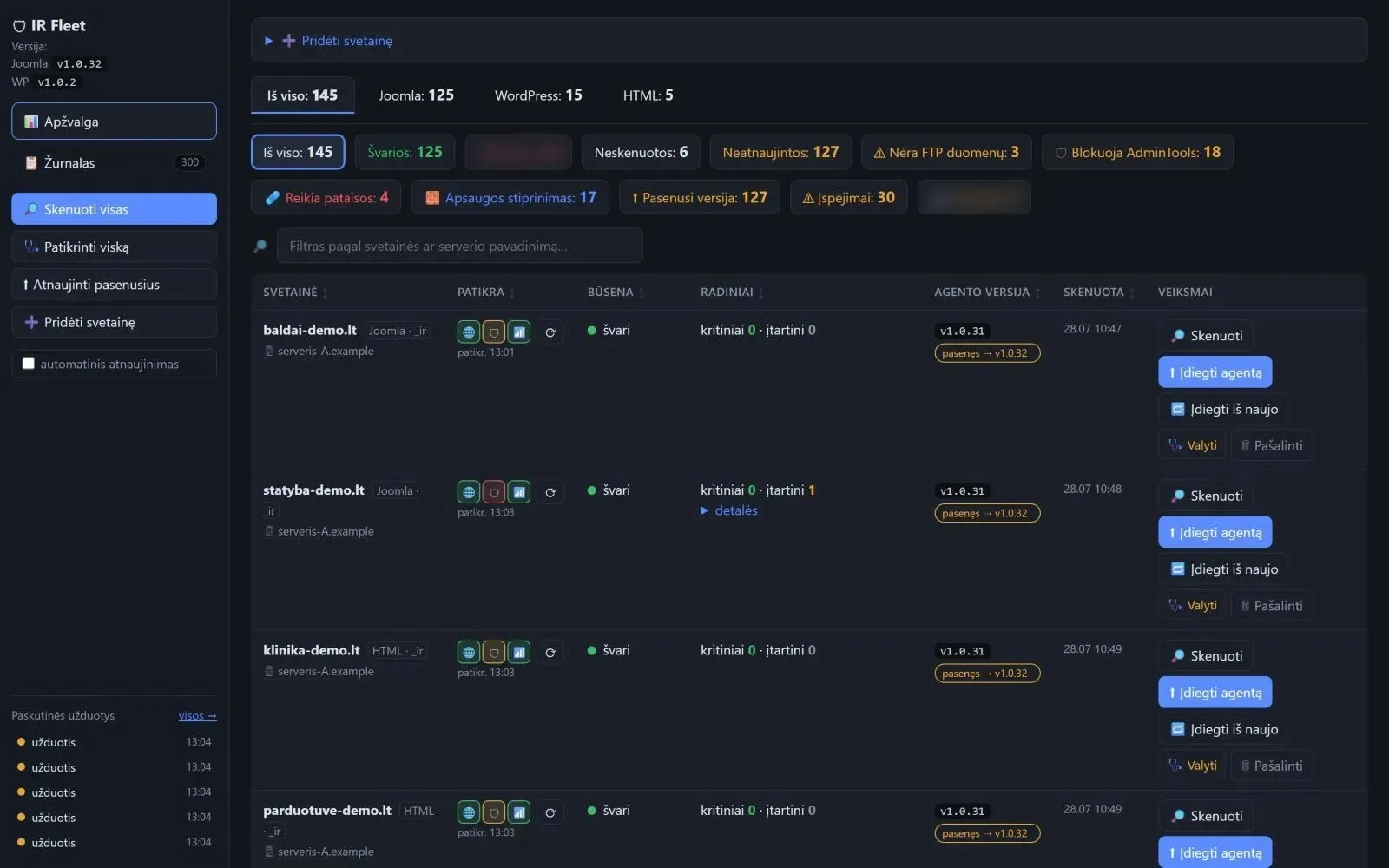
To maintain our clients' websites, we built our own system: one console shows the status of 145 sites (Joomla, WordPress, HTML), runs checks remotely, and deploys or removes scripts over FTP. Each site runs a small scanner that checks the code, core files, database and outdated extensions. We built the system with the AI coding agent Claude Code: it wrote the code, analysed real infections and turned them into detection rules. A human makes the decisions. We can build the same kind of system for a company that runs many websites.
- 145websites in one console
- 1,752automatic scans, July–October 2026
- 92 of 96unpatched holes found are already closed
- 0false positives when tested on copies of infected sites
The brief
The sites live on different hosts and platforms, from plain HTML to Joomla and WordPress with custom extensions. Each one had to be checked separately: connect over FTP, look for suspicious files, check for new administrator accounts and outdated extensions. Infections were often noticed only once they were visible on the site, and after a clean-up a site was sometimes reinfected through the same hole.
The solution
Clean-up tool (June 2026). A standalone PHP tool that works even on a broken site: diagnostics, clean-up with a dry run and a backup before every change, core file restore, hardening. Tested on copies of real infected sites: 0 false positives, plus one backdoor that the manual review had missed.
An agent on every site. A small read-only scanner: malware rules (81 for Joomla, 55 for WordPress), core file comparison against reference copies, new administrators and injections in the database, outdated and vulnerable extensions. Commands reach the agent over HTTPS with a signature; every site has its own key.
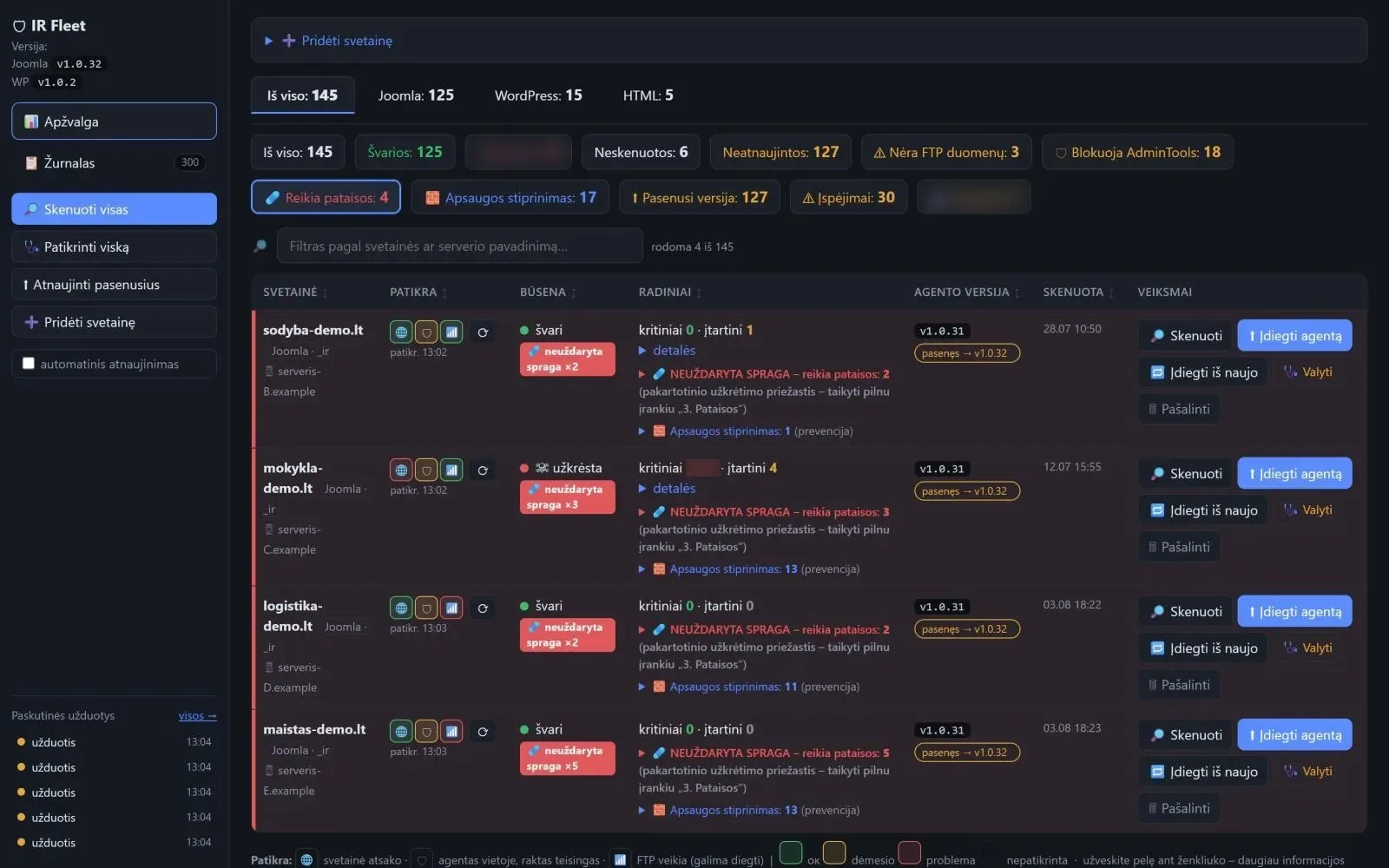
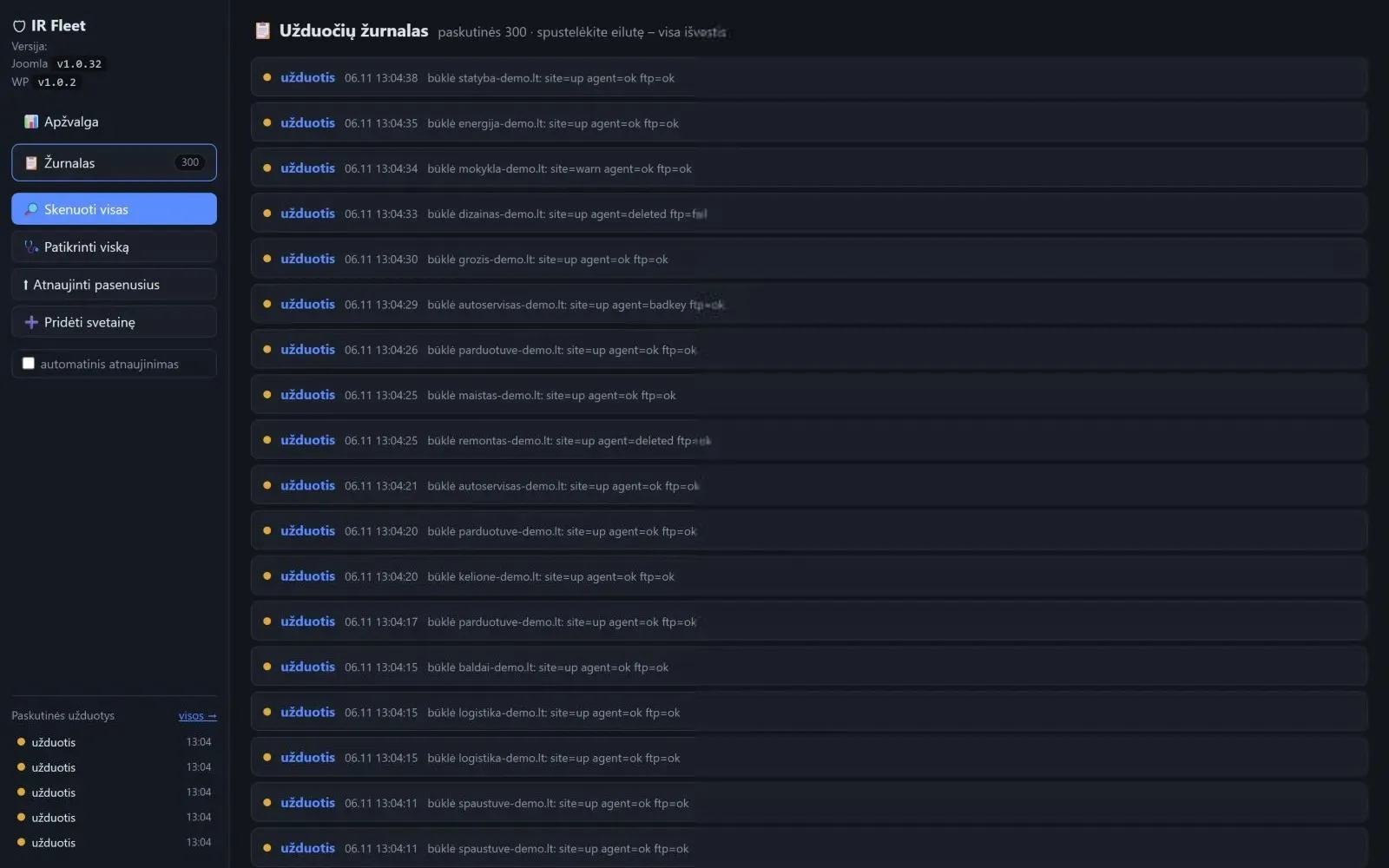
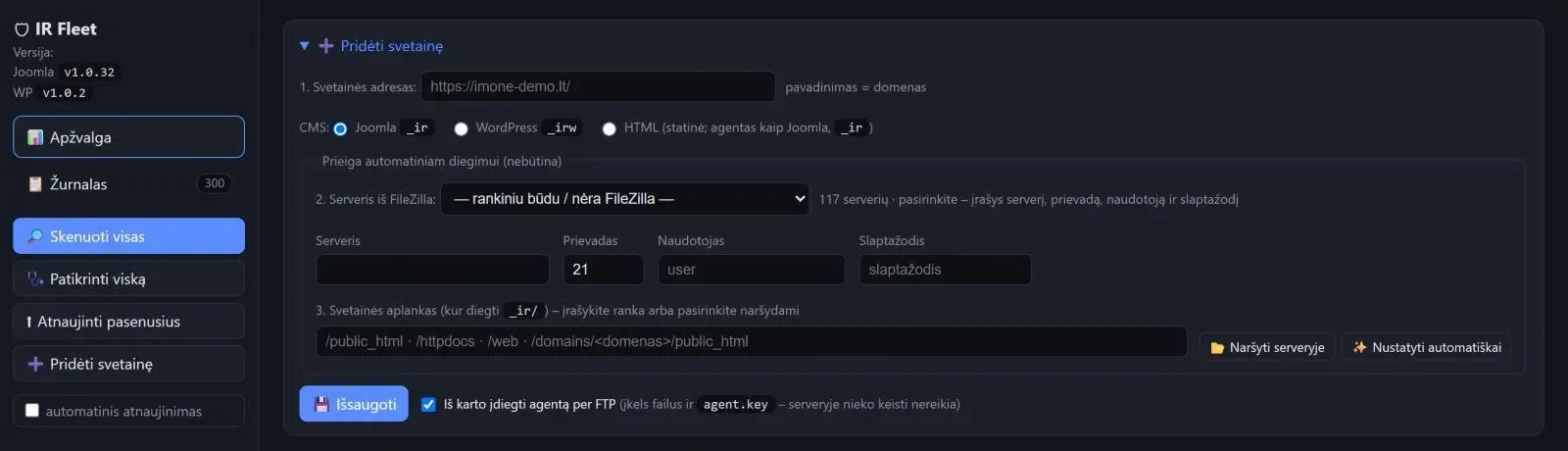
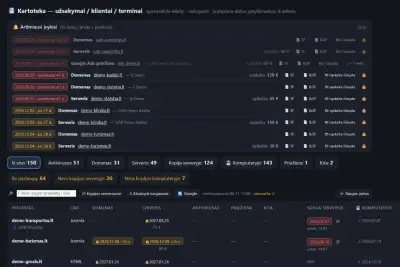
Console (July–October 2026). One window for all sites: status (clean, infected, needs a patch), health indicators (site responds, agent in place, FTP works), filters by status, CMS, site or server, and a task log. A new site is added in a minute: the server comes from the FileZilla list, the folder is detected automatically, the agent is installed over FTP.
Per-server queue. When updating the whole fleet, several servers run in parallel (up to 8), but only one site at a time on each server, so shared hosting is not overloaded. Each update is followed by a scan.
Incident. If an infection is found, the console uploads the full clean-up tool over FTP, a person reviews the findings and cleans in the browser, then the tool is removed and only the monitoring agent stays. The agent has had 32 versions.
Integrations and modules
- FTP / FTPS / SFTP
- HTTPS with HMAC signature
- FileZilla server list
- Joomla, WordPress, HTML
- cron
Result
145 websites (125 Joomla, 15 WordPress, 5 HTML) in one console; 117 servers and hosting accounts. Scan, agent update and removal with one button, for one site or for all at once. 0 false positives when tested on copies of real infected sites. The console shows not only an infection but also its cause: which site still has an unpatched hole. July–October 2026: 1,752 automatic scans of 140 sites; one full pass covers about 2.4 million files. 96 sites had an unpatched hole (an outdated vulnerable extension); 92 of them are now closed. Infections were found and cleaned on 22 sites; 16 sites were already infected at their first scan. Our estimate: checking all sites by hand used to take several days; now it takes a few minutes from the console. Holes are closed before a site gets infected through them. The agent has been updated 32 times after real incidents, so the system keeps up with new attacks. Duration: about 4–5 months of development (June–October 2026). Budget: internal project. A similar system for your company starts at €1,500 (adaptation and installation on your sites, 2–4 weeks); monitoring, clean-up and patching come as a monthly plan from €15 per site per month. What you get (a company with many websites): a console showing the health of all your sites in one window; checks without logging in to each site separately; an alert about an infection and its cause – which hole needs closing; clean-up and patching: files are judged by clear rules and a person, so genuine site files are not deleted by mistake; clear pricing: from €15 per site per month (20 sites from €300 a month). Running 10 or more websites? Within a week we will show you the console with your own sites.
What we would add with AI today
Claude Code (Anthropic, AI coding agent) – code for the console, agents and deployment scripts, the architecture plan, tests on site copies. The same agent – infection analysis: it examined real malicious files (hidden uploaders, trojanised JS libraries, database injections, a fake “Cloudflare” overlay), wrote detection rules for them, found extension vulnerabilities that caused reinfections and prepared patches. The scanner itself does not use AI: it checks against clear rules, so results can be verified and genuine site files are not deleted. What a human checked: approved the architecture – read-only over the network, clean-up only by hand. Tested each new rule on site copies, reviews findings before any clean-up and presses “apply” personally.
Website monitoring
Screenshots
-
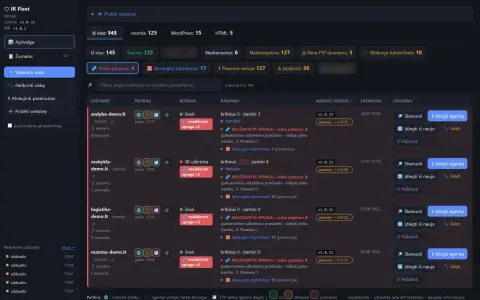
Console filtered by “Needs a patch”: the unpatched hole and its cause for each site -
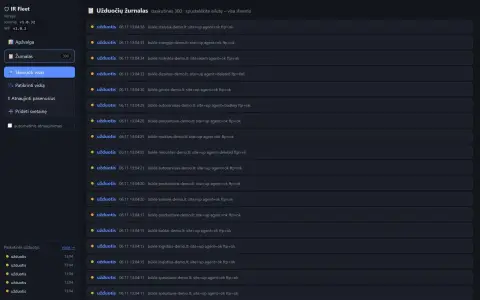
Task log: site health checks with time and result -
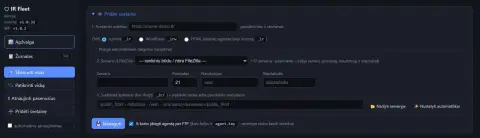
Add-a-site form: address, CMS, server from the FileZilla list and agent installation over FTP

FAQ
Frequently asked questions
Does the scanner itself use AI?
No. The scanner checks against clear rules (81 for Joomla, 55 for WordPress), so results can be verified and genuine site files are not deleted. We used AI to build the system: Claude Code wrote the code, analysed real infections and turned them into detection rules.
Which websites can the console manage?
Joomla, WordPress and plain HTML sites. Our console currently holds 145 sites: 125 Joomla, 15 WordPress and 5 HTML, spread across 117 servers and hosting accounts.
Does the system delete files by itself?
No. Over the network the agent is only allowed to read. A person does the clean-up in the browser: a dry run first, a backup before any change, then diagnostics again.
How much would such a system cost for my company?
Adaptation and installation on your sites starts at €1,500 (2–4 weeks). Monitoring, clean-up and patching come as a monthly plan from €15 per site per month; 20 sites from €300 a month.
Enquiry
A similar solution: website monitoring and remote management
Tell us what you want to automate or connect – we will assess it and suggest where to start.
+370 670 99265Mon–Fri 9:00–18:00
info@saitai.ltWe reply within 1 working day
Alaušo g. 1C, LT-08424 VilniusMeetings by prior arrangement by phone only