

API integration
API integration connects two or more programs through their application programming interfaces (APIs), so data passes between them automatically, without copying by hand. Saitai.lt connects websites, CRMs, online stores, accounting and warehouse systems and third-party services (REST and SOAP APIs), and builds APIs for your partners when needed. We set the price after assessing the systems; the timeline is 2–6 weeks.
In short
- Price
- quoted after assessment: depends on the systems, data flows and API documentation; the assessment is free; no VAT is added
- Timeline
- 2–6 weeks
- Technologies
- REST, SOAP, webhooks, JSON, XML; Laravel (PHP)
- Authentication
- API keys, OAuth 2.0, access tokens, IP restrictions
- What we connect
- websites, CRMs, online stores, accounting and warehouse systems, payment, shipping and AI services
- Warranty
- 12 months
- Payment
- 50% deposit, balance when the integration goes live
- Where we work
- remotely, all over Lithuania; meetings in Vilnius by appointment, arranged by phone
Who it’s for
- The same data – customers, orders, products – is copied from one system to another every day.
- Your systems have APIs, but there's no ready-made module to connect them, or the module doesn't fit your process.
- Partners or wholesale customers want to place orders automatically from their own systems, not by email.
- Website form enquiries, online store orders or call data need to reach your CRM system.
- You use a third-party warehouse, logistics, e-invoicing or AI service and want to connect it to your own system.
- You have an older system you don't plan to replace, but its data is needed by new applications.
When it’s not the right fit
- There is a reliable ready-made module, or a connector on Make or Zapier, for linking your systems, and the process is simple. Then it's cheaper to start with that.
- The system's vendor doesn't allow access to its data: there's neither an API nor an export. In that case, a reliable integration can't be built – it's worth talking to the vendor.
- Data is transferred once a quarter, and there isn't much of it. Then manual export and import will cost less.
Included
What you get
Integration specification
We set out which data travels between the systems, in which direction and how often, which events trigger a transfer, and which system is the source for each field.
Connections to third-party APIs
We build connections to REST or SOAP APIs: authentication, pagination, respecting rate limits and error handling.
Real-time webhooks
If a system sends event notifications (webhooks), data is passed on immediately after the event – for example, a payment or a status change – rather than on a schedule.
Queues and retries
Data is sent through a queue: if the other system is temporarily unavailable, nothing is lost, and the transfer is retried.
An API for your partners
If needed, we build an API for your system: partners can fetch prices and stock levels or place orders, while you manage the access keys and permissions yourself.
Documentation
For an API we build, we prepare documentation (OpenAPI) and a sandbox for partners; for an integration, a description for your team.
Log, monitoring and a 12-month warranty
Every request and error is logged, and you get a notification if something goes wrong. For 12 months, we fix integration bugs free of charge.
Price
How much does an API integration cost?
Price
On request
We price API integrations individually, after checking the systems' API documentation, the data flows and their volume. The assessment is free: within 1 working day, we'll tell you whether the integration is feasible, how much it would cost and how long it would take. If a reliable ready-made module exists for your systems, we'll suggest that simpler route as well.
Prices include all taxes – no VAT is added (we are not VAT-registered). We put the price and timeline in the contract before work starts.
What the price depends on
- How many systems and data flows need connecting, and in which direction.
- Whether the systems' APIs are well documented and whether there's a test environment.
- How much data is transferred and how quickly it has to reach the other system.
- Whether the data needs transforming: mapping codes, standardising formats, merging duplicates.
- Whether an API needs building for your partners, with documentation and access management.
- What the security requirements are: encryption, IP restrictions, an audit log.
Additional costs
- A fee for using a third-party system's API or a licence, if the vendor charges one – paid directly to the vendor.
- If the integration needs a separate intermediary application, it is hosted on Saitai.lt's shared servers, a virtual private server (VPS) or your own server; the price depends on the scope.
- Integration maintenance after the warranty, when systems change their APIs – under a maintenance agreement, agreed separately.
Timeline
How long does an API integration take?
An API integration takes 2–6 weeks from receiving the deposit and access to the systems. A one-way transfer of one data type between two systems takes 2–3 weeks, while two-way sync across several systems, or an API for partners with documentation, takes 4–6 weeks.
| Scope | Example | Timeline |
|---|---|---|
| One-way transfer | website enquiries into the CRM, orders into the warehouse system | 2–3 weeks |
| Two-way sync | customers and orders between the CRM and the online store, statuses sent back | 3–5 weeks |
| Several systems or an API for partners | CRM, accounting and warehouse; an API with documentation and access keys | 4–6 weeks |
Process
How it works
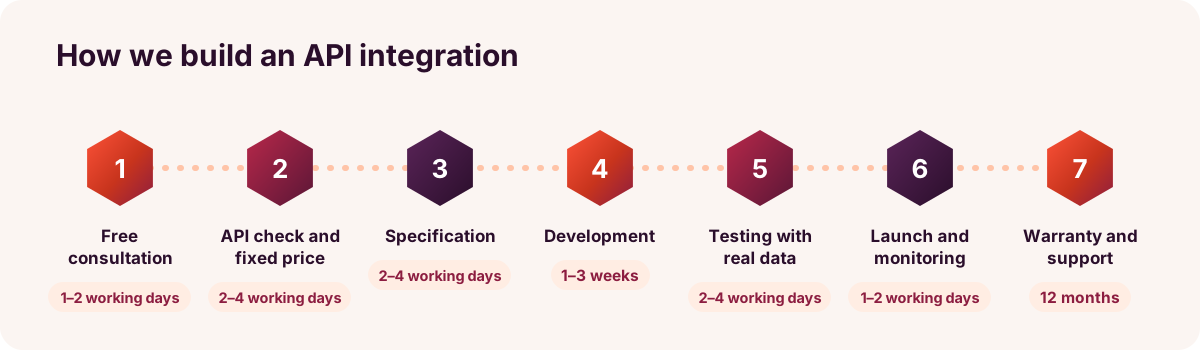
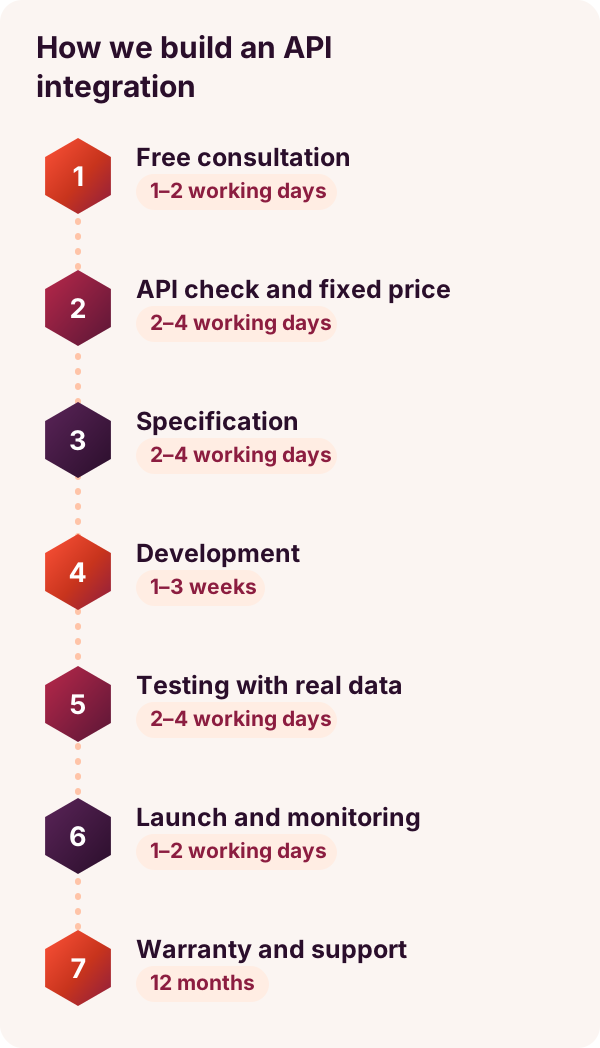
- Free consultation1–2 working days
We find out which data is currently copied by hand, how long that takes and which systems are involved.
- API check and fixed price2–4 working days
We check the API documentation, access methods, rate limits and test environment. The price and timeline go into the contract, and we start once we receive the 50% deposit.
- Specification2–4 working days
We document the field mapping, events, error cases and which system is the source of each piece of data.
- Development1–3 weeks
We build the connections, queues, log and notifications, and run a test version in a test environment.
- Testing with real data2–4 working days
We test both normal and error cases: duplicates, an unavailable system, incorrect data.
- Launch and monitoring1–2 working days
We switch the integration on and, for the first few days, check the log and whether the data matches in both systems.
- Warranty and maintenance12 months
For 12 months, we fix integration bugs free of charge. If the other system's API changes, we adapt the integration under a maintenance agreement.
Comparison
A ready-made module, a connector platform or a custom API integration?
| Criterion | Ready-made module | Connector platform (Make, Zapier) | Custom API integration (Saitai.lt) |
|---|---|---|---|
| Upfront cost | module licence and configuration | low, if you build the connection yourself | quoted after assessment |
| Monthly costs | licence renewal, if the module is paid | platform plan based on the number of operations | only hosting and maintenance, if needed |
| Customisation | only what the module offers | wide, but complex logic becomes hard to maintain | built around your rules and data volumes |
| Large data volumes | depends on the module | costs rise as operations grow | designed for large numbers of records |
| Where the data goes | directly between your systems | through a third-party platform | directly between your systems or via a server of your choice |
| Best for | a standard process, with a maintained module | simple flows and quick experiments | non-standard, high-volume or sensitive data flows |
Examples
Typical projects
Manufacturer and partner orders
- Situation
- For example, a food manufacturer receives orders from retail chains and wholesalers by email, and sales managers re-key them into their own system.
- Solution
- An API is built that partners use to place orders and check their status; larger partners get documentation and a sandbox. Orders go straight into production planning.
- Result
- Fewer re-keying errors, faster order confirmation and a clear process for onboarding new partners.
Website, CRM and accounting in a service company
- Situation
- For example, an IT support company receives enquiries through its website, manages contracts in a CRM system and issues invoices in its accounting software. The same customer is entered three times.
- Solution
- A website enquiry becomes a CRM record, once the contract is signed the customer is passed to the accounting software, and payment statuses flow back into the CRM.
- Result
- Each customer entered once instead of three times, and payment visibility for sales managers without calls to the accounts team.
Online store and fulfilment centre
- Situation
- For example, an online store keeps its stock at a third-party fulfilment centre and sends it orders as an Excel file twice a day.
- Solution
- A paid order is passed straight to the fulfilment centre's system via its API, and the tracking number and status come back to the online store.
- Result
- Faster dispatch, tracking numbers sent to customers automatically and stock levels that match the warehouse.
Tell us your systems – we'll check their APIs for free
Tell us which systems need connecting and which data has to travel automatically. If you have them, add links to the API documentation. Within 1 working day, we'll tell you whether the integration is feasible, how much it would cost and how long it would take.
FAQ
Frequently asked questions
It's an automatic conversation between two programs following pre-agreed rules. One system sends a request to the other system's API – for example, "create an order" or "what's the stock level for this product?" – and the other replies in a set format. The integration is a program that carries out these steps by itself, on a schedule or when something changes.
More
Related services
Integrations for online stores and business systems
Solutions for accounting, payments and shipping – from €150.
Online CRM for teams, with access rights
Online CRM from €1,900; enquiries and orders can be passed into it automatically (the integration is quoted separately).
Laravel development
New modules and APIs for existing Laravel systems.
AI integration into websites and systems
AI processes emails and documents, and the data flows on to your other systems – from €990.
Enquiry
Get an API integration estimate within 1 working day
Tell us which systems need connecting and which data has to travel automatically. You can add links to the API documentation in your message. Tel. +370 670 99265.
Phone / WhatsApp / Viber:
+370 670 99265
Email:
info@saitai.lt
We reply within 1 working day. Meetings in Vilnius are by appointment only – please call first.

