How website development works: 7 stages from enquiry to launch
Website development runs in 7 stages: enquiry and call, brief and quote, contract and deposit, design, development, content, then testing and launch. Saitai.lt builds a one-page website from 5 working days, a business website in 10–25 working days and a Premium website (up to 30 pages, 2 languages, UX prototype) from 30 working days. The clock starts once we have received the deposit and the website content.
A one-page website (landing page) takes from 5 working days, a business website 10–25 working days and a Premium website of up to 30 pages from 30 working days. The timeline depends less on the development itself than on how quickly the design is approved and the text and photos are supplied.
The stages and how long they take – more detail in the table below.
Stage
What we do
What you do
Duration
1. Enquiry and call
We reply, ask questions and review your current website
You describe your business and send examples of websites you like
1–2 working days
2. Brief and quote
We draw up a page list and a description of the features, and calculate the price
You clarify and approve
1–3 working days
3. Contract and deposit
We prepare the contract
You sign it and pay a 50% deposit
4. Design
We design the home page and one inner page
You give feedback and approve
2–8 working days
5. Development
We install the CMS and build the page templates, forms and features
You review an interim version
5–12 working days
6. Content
We add the text and photos and set up the SEO basics
You supply the content or order copywriting
7. Testing and launch
We test the website and move it to your domain
You approve the launch
1–2 working days
The first three stages happen before work begins, so they don't count towards the deadline in the contract. Development and adding content usually run in parallel, which is why the table gives one duration for both.
1. Enquiry and first call
We reply to enquiries within 1 working day, and the consultation and initial estimate are free. The aim of the first call is to understand what the website has to do for your business and to tell you which option fits: a one-page website, a business website or a custom project.
We usually ask:
what the company does and who its customers are;
what a visitor should do on the website – call, fill in a form, sign up;
whether you already have a website, a domain and a logo;
who will prepare the text and photos;
whether you need several languages or a connection with other systems, such as a CRM;
when the website has to go live and what budget you're working to.
We also review your existing website and tell you what's worth keeping: pages that work well, text, or URLs that bring visitors in from Google search.
2. Brief and quote
After the call, we draw up a list of pages and a description of the features, along with the price, the deadline and what is not included in the price. If you've already written a brief, we review it and flag the questions that need clarifying. If you're writing one yourself, our article ‘Ordering a website: what to prepare and how to write a website brief’ explains what to include.
3. Contract and deposit
The price, deadline and scope of work go into the contract, and the feature description becomes part of it. We start work once we receive a 50% deposit; you pay the balance after the website goes live. Prices include all taxes – no VAT is added (we are not VAT-registered).
The domain is registered in your name. Even if we take care of the registration, the domain belongs to your company.
Extra work only when agreed in writing. If a new feature is needed during the project, we agree its price and deadline first.
One person in charge. Agree in advance who in your company will approve the design and content.
4. Design
Design starts with two pages – the home page and one inner page. We revise them based on your feedback and then apply the approved design to all the other pages; that way, changes cost the least. Every layout is also designed for a phone screen, because many visitors open a website on their phone first.
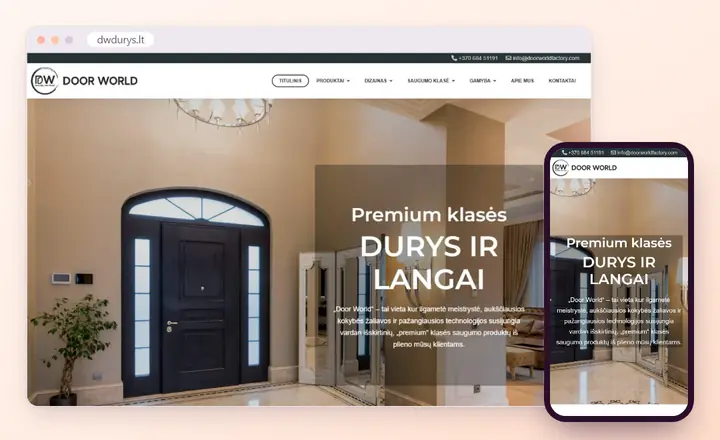
The same design on desktop and mobile: the Door World website, built by Saitai.lt. View the project
For a business website, the scope of the design depends on the package: Start – a template adapted to your colours and logo; Business – a custom design; Premium – a custom design with a user experience (UX) prototype. More on our page about web design.
Feedback is easiest to give as a single list, once you've gathered the views of everyone who makes decisions. Check the layout on a phone as well: menus, buttons and forms look different there than on a computer screen.
5. Development and the content management system
Once the design is approved, we install the content management system (CMS) and build the page templates, forms and other features. For most business websites we choose WordPress, for some projects Joomla, and when non-standard logic is needed – such as bookings, calculators or a connection with your systems – we develop on Laravel. We choose the system based on the features and how you'll manage the content yourself.
You review the interim version in a staging environment, so you can give feedback before launch, while your current website keeps running unchanged. You can see what working with the most popular system looks like on our page about WordPress website development.
6. Content: text and photos
You can supply the content yourself, or we can prepare it: copywriting costs from €29 per page. The copywriter works from the information you provide and the words your customers use when searching for your services. It's best to have your own photos: stock images show neither your team nor your work.
Send text in an editable format (Word or Google Docs), with a separate file for each page.
Send photos at their original size – we'll resize them and convert them to WebP ourselves.
If you don't have a logo, we can design one (logo design from €120).
If you're replacing an old website, mark which of its pages and text should be moved over.
While adding the content, we also set up the SEO basics: each page's title and description, the heading structure, structured data and the sitemap.
7. Testing and launch
Before launch we test the website against a checklist, and we only put it live once you've approved it. Testing and moving it to your domain usually takes 1–2 working days.
Display on phones, tablets and different browsers.
Forms: a test enquiry must reach your email.
Links, the error page and loading speed.
An SSL certificate and secure HTTPS on every URL.
A cookie consent banner and Google Analytics 4 (in the Business and Premium packages): analytics cookies are only set once the visitor consents.
301 redirects if an existing website is being replaced: each old URL must lead to the matching new page, not to an error.
It's also worth checking the accessibility basics: do images have alt text, is the text contrast sufficient, can the form be completed using only a keyboard? This makes the website easier for every visitor, not just people with disabilities.
What happens after launch?
After launch we show you how to edit the content and hand over a short guide; once full payment is received, we also hand over the admin logins, the website files and the database. There is a 12-month warranty from launch: if the website doesn't work as agreed, we fix the bug free of charge.
The warranty doesn't cover content changes or new features that weren't in the brief.
Hosting costs from €60/year and a .lt domain from €8/year; in the Business and Premium packages, the first year's domain and hosting are included. More on our page ‘Hosting and domains’.
Maintenance from €29/month: monthly updates, weekly backups, uptime monitoring and up to 30 minutes of changes a month. For a business website, maintenance is free for the first month with the Business package and for the first three months with Premium.
New work after launch is charged by the hour (€30/hour) or according to a quote agreed in writing.
You can also maintain the website yourself or hand it over to another specialist: it belongs to you, so it can be moved to a different hosting provider too.
What mistakes should clients avoid?
Projects are most often delayed not by technical problems but by waiting for decisions: late content, feedback from several people arriving at different times, and changes to the structure after the design has been approved.
The content arrives in the final week. Development can go ahead without it, but the launch can't. Start preparing the text while the design is being done.
The structure changes after the design stage. A new page type or menu section after approval means extra design and development work.
No single decision-maker. When several colleagues send feedback that contradicts itself, every round of revisions takes longer.
The design is only reviewed on a computer. Your customers may see something quite different on their phones.
Old URLs are forgotten. If your current website already brings in visitors from Google, tell us in advance so we can plan the redirects.
Accounts not in the company's name. Register the domain, hosting and analytics accounts in your company's name, so you don't depend on one person.
Planning a new website? Describe your business and the website you want in the enquiry form. You'll get a reply with a provisional price and timeline within 1 working day. You can browse our completed projects in the ‘Website examples’ section.
Yes. While the website is being built, it runs in a separate staging environment, and we send you its address. There you can review the pages on a computer and a phone, try out the forms and note down your feedback. If an existing website is being replaced, it keeps working as usual, and we only move the new version to your domain once you've approved it.
What will I own once the work is finished?
The domain is registered in your name. When the project is finished and paid for, you receive all the admin logins, the website files and a copy of the database. This means you can later choose a different hosting provider or developer. If the website uses paid themes or plugins, their licences are subject to the vendors' terms.
Can the design be changed after it has been approved?
It can, but that counts as extra work. We assess any changes – from a shade of colour to a new page type, a different menu or layout – and agree their price and deadline in writing before making them. That's why it's worth approving the design only once everyone who makes decisions has reviewed it.
How much does a website cost?
The cheapest option is a one-page website, from €399. Website packages for businesses: from €499 (up to 5 pages), from €899 (up to 15 pages, custom design) and from €1,490 (up to 30 pages in two languages). Prices include all taxes – no VAT is added. You'll find a comparison of the packages and the annual running costs on our page ‘How much does a website cost?’
Can you move content from an old website?
Yes. We move text, photos and documents, and set up 301 redirects for the old URLs so that visitors and search engines land on the new pages. The amount of content to migrate affects the price, so during the first call we go through together what's worth moving, what to update and what to drop.
To appear in ChatGPT answers and Google's AI Overviews, your website must be indexed by Google and Bing and reachable by AI search crawlers, and your most important…
A CRM system (Customer Relationship Management) is software that keeps your customer contacts, enquiries, quotes, orders, tasks and the full history of every…
SEO (search engine optimisation) means improving your website so that search engines can easily find it, understand it and rank it higher in the free (organic)…